
There was a great story on All Things Considered last night about the in-store artists that Whole Foods employs to create their unique signage. They employ them full time and provide health benefits. Wow. Read or listen to the story and if you're not already familiar with them, learn more about this remarkable business.
Wednesday, November 29, 2006


The New WesterBlog - NOW WITH COMMENTS!

Just a quick note to let you know that I've made a couple of modifications to the WesterBlog. The biggest is that I have enabled commenting (you have Larry Miller and his persistent lobbying to thank for that). Just remember to be nice and let's get some conversations started.
Not so new but worth a mention - I've also added category labels for my postings so now you can search for all of my rants by subject (located on the top right hand sidebar under the heading 'Labels' - just below my ugly mug). Enjoy! And if you are enjoying, feel free to comment.
Monday, November 27, 2006
I'm Nick Westergaard and I Approve This Blog Post
A recent study pointed out some stunning stats on political advertising. During this month's election, a viewer watching a 30-minute block of television was, on average, exposed to 4 1/2 minutes of political advertising. The real kicker? In a 30-minute newscast viewers only got about 1 minute 43 seconds of political coverage and even then it focused primarily on political strategy rather than a look at how the candidates actually differ on the issues.
Speaking of stance on the issues ... I'm not real sure where I stand on this. I guess it would be easy to say "yeah advertising!" but I kind of feel more like "forget advertising (in politics: spin), where's the beef?" I guess, love it or hate it, our society is really getting most of our information, on anything from pharmaceuticals to MP3 players to the people we elect to higher office, through perceptions shaped by mass media.
The Point? With reluctance, I say go advertising ... but we need to be careful. As David Ogilvy once said, "In a period when television commercials are often the decisive factor in deciding who shall be the next President of the United States, dishonest political advertising is as evil as stuffing the ballot box." You're now more than twice as likely to hear controlled spin from a politician than an objective fact so just remember that an ad for a politician is as objective as one from McDonalds espousing the dietary benefits off the Big Mac. Luckily our food has Nutrition Facts ...
Thursday, November 16, 2006
Chuck Gets It
 Larry points us to Slate where Seth Stevenson gives an Ad Report Card for the new "animated-reality" TV ads that Charles Schwab is using to announce their lower pricing structure. This article provides an in depth anatomy of an ad and is also a great example of targeting your message to an audience (men w/impotent anger who are upset at how their money is being managed). It even goes a level deeper and uses the media in a way that creates the right effect on this market segment (the ads leave you with a disrupted feeling -- it could really push the target audience into taking action). Kudos to Austin-based GSD&M for a kickin' strategy and execution. Well played. Quick things I love about these ads:
- The "Talk to Chuck" slogan. For the exact same reasons Slate points out. Saw it on a big billboard in Chicago and fell in love with it.
- The fact that for research Schwab created a "clutter reel" assembled of the bad advertising that is prevalent in financial services space (Adirondack chairs, sailboats, etc.).
- The strategic match up of a targeted message and a targeted media
P.S. If you find a link to the Schwab ads, send it to me and I'll post it.
Tuesday, November 07, 2006
Buzzwords
Here is a great article on buzzwords from Yahoo! Finance. (Thanks to Mike for the referral.) It's a great read if you can find time in your day between working on your deliverables and your decentralization and unsiloing efforts and provided you don't have any drive bys from knowledge workers or managers who manage by walking around (MBWA).
Monday, October 30, 2006
The [Non-Business] Business Book
 Last week I was in the Denver airport waiting for my flight home and I was faced with an unsettling feeling: I am bookless. There are so many books that I feel I need to read: Freakonomics, The Long Tail, or the one that I thought was at the top of my stack, Small Is the New Big by Seth Godin.
But as I scanned the shelves at the Hudson Booksellers the words of my wife and so many of my colleagues echoed in my head: "If you read another business book next, I'll kill you." Sounds threatening but I really do have a problem with this. It's unintentional. And I'm not trying to brag but I just read these books faster than others. (I must have a problem with fiction in general. Even when not reading business books, I love non-fiction. Sports non-fiction, memoirs, essays, and biographies.)
I was especially antsy that night because it was Game 3 of the World Series and I had to get to the airport sports bar to watch as much as I could before going "silent" on the plane. (I'm a bit of a Cards fan by default -- they're my son's favorite team. I prefer the more tepid, lukewarm response that I like all Midwestern teams equally.) So it was probably a subliminal thing that led me to purchase 3 Nights in August, Buzz Bissinger's take on a 2003 three-game series between the Cubs and the Cards told through the transitioned lenses of manager Tony LaRussa.
Well, the Series came out just like I wanted it to and the book appears to be headed that way as well. I've also come to the conclusion that 3 Nights in August, is actually what I'm calling a non-business business book. By that I mean seeing the series through Tony's eyes, you get a feel for the elements of strategic planning and management that go into a game simplistically referred to as "America's past time." You see LaRussa pouring over video and statistics but not being totally driven by them. This is important: he straddles the line of intellect and intuition in a way that is applicable to several aspects of day-to-day life in modern baseball and business.
He also posses what Tom Peters calls a "bias for action." When in doubt, do something. We see LaRussa's now famous (back then, thought to be crazy) experimenting with the injured Albert Pujols' position to get him back into the line up as a perfect example of trying something to get results (which he did).
The Point? I'm not saying Transition Tony is Peter Drucker but you might find this read interesting and surprisingly applicable. Plus, if you're a baseball fan it is a hell of an easier read than Drucker. I think 'The Point' is also like Tony pacing around and tinkering with the line up. You have to expose yourself to all kinds of non-linear things to be open to a crazy idea that could be the equivalent of getting Pujols back into your line up.
P.S. You might also enjoy this post by Tom Peters, if for nothing else than his free PowerPoint on Think vs. Do. Enjoy!
Monday, October 16, 2006
I'm Taking Pictures of My Trash Again
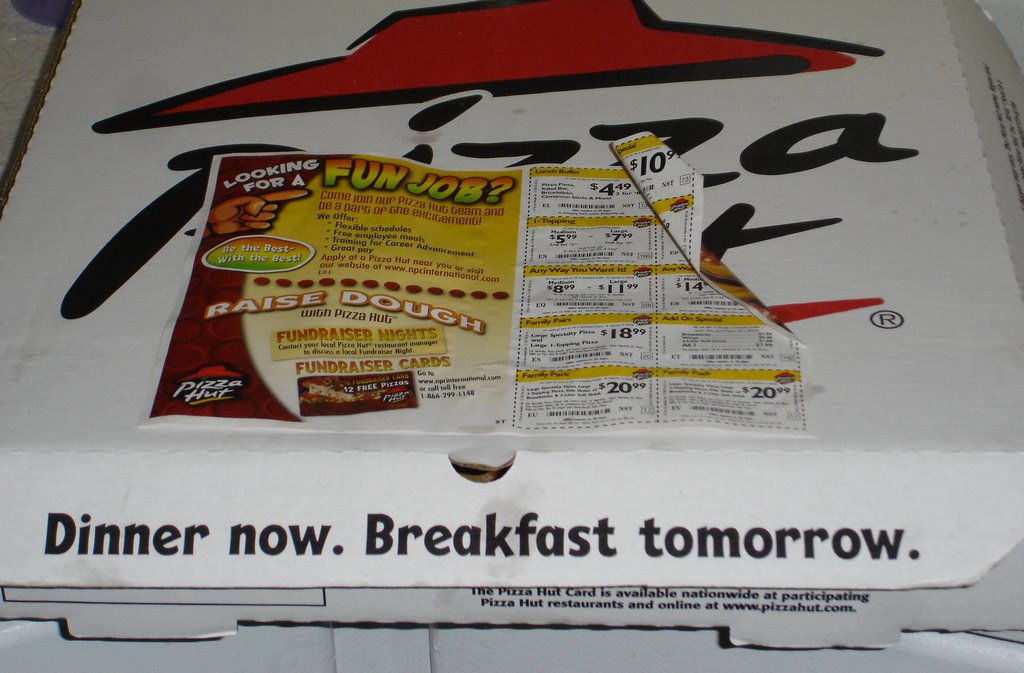
Again, you say? Yes. As some of you may remember I was similarly moved by some fast food packaging that I had to photograph and blog about pre-trash last year. Anyhow, I love this Pizza Hut box because they took advantage of their packaging to touch on a unique product need. "Dinner now. Breakfast tomorrow." Those four simple words sum up the added value of ordering pizza. Some clever copywriter took a personal moment of product interaction - not just the key customer need of satisfying immediate hunger - and found a way to market to it. Those sentences remind us why we have twice as much pizza delivered as we need.
The Point? Embrace and find a way to market to an atypical use for your product. I say embrace because I remember the story about the Preparation H marketing exec on the ski slope that begrudgingly admitted that a number of their customers (the skiing exec included) used the product as an exceptional cold weather lip balm. Now what if they found a way to embrace that need and market to it. And finally, remember that it's not just a box, or a sack, or an invoice. It's a piece of advertising that will be laying around your customer's home or office. Make the most of your packaging or I'll be forced to take more pictures of my trash!
Subscribe to:
Posts (Atom)


