My blog has moved!

You should be automatically redirected in 6 seconds. If not, visit
http://westerad.com
and update your bookmarks.

Showing posts with label Customer Service. Show all posts

Thursday, December 18, 2008

Can I Help You?

You walk up and down the aisles of a store ... Can I help you?

You call up your trusted business advisor ... Can I help you?

Can I help you? This is the battle cry of the service trade from front line customer service to skilled professional service practitioners. Whether you work in a call center or a hospital, your exchange with those you serve usually begins with some variation on can I help you?

Given the current economic climate, this phrase takes on an even more complex and urgent meaning. Our customers' circumstances have changed, people are making decisions differently, and - most of all - our lives are more complicated. Now more than ever, people are looking for help beyond having their basic needs met. We all need to ask ourselves, is there something more we can be doing to serve our customers. Even something small ...

Earlier this week I got an email from Staples with the subject line 'Will Office Depot closings affect you?' which included a brief news re-cap about the closings and info on the stability of Staples. Initially I thought that this was a shrewd move – capitalizing on the weakened status of a competitor. But then I thought about it for a bit. Maybe there's not a lot of brand loyalty in the office supplies business. Staples vs. Office Depot vs. Office Max. Maybe people just duck into what is closest to them. And with one of the giants fallen, maybe someone's already-complicated life could be pushed even further if they didn't know where to get their paper clips. People are looking for security and reassurance. And in one little email Staples went a long way toward communicating that.

Staples took a step back and asked can I help you? When you consider this with the fact that Staples has built it's brand on ease of use (Staples - that was easy) it becomes more than obvious that this was a brand-savvy, customer-centric move in a critical time when we all need to need to be doing that. When we need to remember to ask - Can I help you?

Tuesday, September 04, 2007

The Southwest Business Model

If you don't already know the story of Southwest Airlines, you should. Take a quick minute at the beginning of a post-holiday week for a quick refresher courtesy of a segment from last weekend's CBS Sunday Morning - you can read the text or watch the video here. Basically, it all comes down to a seemingly simple business model projected by the airline's former CEO, Herb Kelleher. He asserts that if you focus on your employees then all of the rest will fall in to place. Because if you take care of your people, then they project their pleasure onto your customers, who in turn have favorable experiences and continue buying, which in turn pleases your stock holders or whoever your business serves. Herb's also responsible for one of my favorite quotes: "We have a strategic plan. It's called doing things!" No bull. Just a remarkable company.

Tuesday, February 20, 2007

It's the Big Things Too ...

... that can save you from certain doom. We all know about the week JetBlue's been having so I'm not gonna bother to recap. How do you come back as a business from a nightmare like this? Today JetBlue announced their Customer Bill of Rights. Nothing real exciting on paper but remember the old adage of "it's not what you say, it's how you say it"? Well, what's gonna save JetBlue is how they've said their Customer Bill of Rights.

Go to their website and they've posted it clearly on the homepage (big duh after a bad PR week - you do NOT want to hide your response). BUT what they've posted isn't a document stating the rights. In fact at a cursory glance I can't find any webpage or pdf that lists them in writing. No, this link takes you to a YouTube video nested in the site of JetBlue founder and CEO David Neeleman telling you the Bill of Rights. Not a typical CEO standing at a podium addressing the troops. It's an intimate setting with Neeleman in a open-collared shirt talking about their FUBAR week and his promise (the company's too - but the implication is that he's
personally vouching) on how their going to make it better. And the cherry on the sundae - he closes by asking for your business. Well played, JetBlue.

And it didn't stop on the website. Neeleman was all over TV this morning making the rounds. They responded quickly enough to get into the news cycle and may end up changing the story. My prediction? JetBlue is going to come back from this. They're a remarkable business that is working to handle a terrible misstep remarkably.


Speaking of which ... do you have a Customer Bill of Rights? If so, is it on your website? If it's on your website is it buried?

Monday, January 15, 2007

Food for Thought

An oldie but goodie with a slight addendum in light of the impact of social media.
  • A customer who is pleased after doing business with you tells one person
  • A customer apathetic to your experience tells no one
  • A customer who has a bad customer experience tells approximately nine people OR ...
  • ... they blog about it and you experience the online firestorm that Kohls has had after someone's cell phone camera met up with a messy dressing room

Wednesday, August 23, 2006

Black on the Edge of Customer Service

Those of you who know me personally, know I love rage-comic Lewis Black. Those of you who read this blog frequently know that I also love good customer service. So what a treat I got this week when I received the current issue of Fast Company in which they recognize good customer service with their Customer First awards. On the cover was Lewis Black, steam coming out of his ears, with the headline "Is This Your Customer." For me, this is right up there with their issue titled "The Boss from Hell" that featured Mr. Burns on the cover.

And to top it off, this wasn't just Lewis Black "modeling" and setting the tone for the issue with a cover photo. There's actually a great article where "Our customer-service curmudgeon suffers for all of us--but not in silence." It's an insightful read that offers a raw take on the state of service today.

Now take a step back and think about the impact of this cover design. (Actually, you could do this with any of Fast Company's cover designs.) Instead of doing the average BS about "The Customer Service Issue" with some sort of warm and fuzzy customer interaction photo they took it to the edge with the winning concept of the pissed-off customer. But the edge wasn't far enough so they scooted out a bit more and took it from being a generic pissed-off customer to one of America's most notorious pissed-off customers.

So, go to the edge and then move out a couple more inches just to make sure you're far enough!

Take this yet another step back and you can apply the concept of going to the edge to anything from business to backgammon. You can even apply it to the stage persona adopted by Lewis Black. Which would you rather hear? Another comic with a meandering story about airline service gone awry or a jolting rant from a man who appears to be on the verge of an aneurysm? Black even mentions as much in the interview. He recalls studying classical theatre and only discovering comedy because friends told him he was funny when he was pissed off. And the pissed-off thing seems to be working well for Black (regular Daily Show commentaries, three movies coming out, best-selling book, albums, etc.).

So, go to the edge if for no other reason than, to quote a Texas politician, there's nothing in the middle of the road except yellow lines and dead armadillos.

Thursday, July 20, 2006

My Favorite Store That I Haven't Bought a Thing From (Yet)

Story time at the WesterBlog. Gather 'round ...

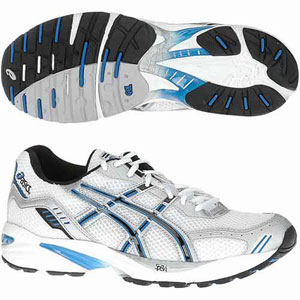
I run. Not real well but I run nonetheless. On Wednesdays I run with a group of triathalonians and ironmen. It's something of a brutal self abuse regimen. I run because I can't work out in any other way. I'm uncoordinated and have been banned from most sports involving a ball and I would rather drink paint thinner than sit in a weight room.

I digress! I also like running because I can think about things like ... my blog posting. For reasons like this running has become more and more important to me. Recently my old running shoes started cutting my Achilles. So I brilliantly surmised that it was new shoe time.

My favorite shoe store now is Running Wild here in Coralville. I say 'now' because did I go there when my shoes first gave out? No. I'm a cheap SOB and I went to Kohl's for $35 Nikes. They looked cool. But they started squeaking and squishing when I ran. I returned them but the other pair did the same thing. Basically, these shoes suck and you would be hard pressed to call the staff at Kohl's helpful on resolving the matter. So my shoes suck and I decide to just wear them until I've gotten my $35 out of them (it's been a couple of weeks -- I think I'm almost there).

Around this same time my wife got me a running hat for Father's Day from Running Wild. In the bag was an invite to their Sunday morning runs. A group meets at the store and runs as much as 16 miles or so. They've got maps, water along the route, and bagels and juice at the end in the store. But that's where the magic happens. That's where I got to hear their expert staff sell shoes.

"Well, these are my old shoes ..."
"Ah ... I see. It looks like you're right handed ..."
"Yes"
"... and you run on the outside of your foot."

All of that by looking at the old shoe! Maybe this isn't reading tea leaves like I think it is but compared with my Kohl's experience ...

"These shoes make a weird sound."
"Did you try on another pair?"
"Yeah. They make the sound too."
"Uhhh ... I don't know what to tell you."
"Can you recommend another pair?"
"I don't usually work in this department. Sorry."

Compared to that it was like hearing a mystic tell the future. (Instead of reading palms he was reading feet!) I made a decision then and there that this would be my new favorite shoe store and my replacement 'new' shoes would come from here very soon. This experience showed me that expert advice is worth paying full price for. It is also a perfect case study for how to add value to the customer experience.

And how about that weekly run? I'm sure that's a decent-sized amount of money and labor for a small business. Water, bagels, juice, opening the store up at 7:00 a.m. But it got me to the store and let me see something that you can't put on a sign that you can see from the highway. Ironically they have a sign in the window that I have seen from the highway that says 'Expert Advice' but never paid attention to it but when I witnessed it in person ... Wow.

There's not copy to describe something like that. It's something you have to experience. Because, at the end of the day, that's what you're buying from a store like Running Wild. Not shoes or running gear but the experience of getting these commodities from a learned expert. Bravo.

Friday, July 14, 2006

The Real Front Lines of the Customer Experience

Seth Godin makes a great point about receptionists. It pays to make every step of a customer's experience remarkable. Receptionists are your advance team who make impressions on your clients very early in the sales process. Sometimes this interaction is enough to make or break the whole relationship.

Another way to look at it: think about the other items on the front lines of your customer experience -- business cards, letterhead, packaging, and the like. Do you spend as much time and careful consideration making sure your receptionist is as unique and personal as your business card? And I'm not talking about someone with the basic social skills to work at Any Office USA. I'm talking about someone with personality and funk who embodies what it's like to be in business with you.

Monday, November 28, 2005

2 Groups of People

Recently, I switched jobs. As a marketer, I was faced with the task of preparing items for my successor while concurrently planning my own agenda as someone’s successor.

As I thought about the quandaries faced by both myself and my successor — how to get up to speed and synthesize data to market an unfamiliar product — I realized that essentially this daunting chore comes down to forging strong relationships with two separate but equally important groups of co-workers.

In a recent post, I mentioned a quote that cited essential pieces of knowledge that all marketers need to create a truly product-centric marketing program — information on the products and the customers. The following two groups of people can help you get both.

Product Development
The people who create your product give you invaluable insight on many of the questions that you need answers to. This product had to be developed for a reason. These are the people to ask. What’s different about the way we make our widget? Is there a secret sauce? It will soon be your job to communicate all of these ideas to the marketplace. You need to soak up as much information from this group as possible.

Sales/Customer Service
I lump these two groups into one super group because titles and org charts aside, basically what I’m saying here is that the second group is the staff on the front lines with your customers. The yin to product development’s yang, these individuals have a unique understanding for why your customers need your product.

And yet it goes beyond that. They know about the market’s values too. They know they don’t just want a better widget. They want a better widget so they can make their lives or the life of their business better. Your front line staff is key to helping you translate the product’s features into a compelling solution that will appeal to your market.

The Point? The whole ‘2 groups of people’ idea initially struck me as a big ‘duh’ but the more I thought about it, the more imperative it became to concretize this concept. Plus, after you mentally label these co-workers as a resource, you then prime your brain to catalog each encounter with these invaluable individuals as an important experience.

Monday, October 24, 2005

... And Don't Forget to Patch Your Potholes


Yesterday, I encouraged you to walk through your customer experience to maximize your touchpoints. While looking for touchpoints, keep your eyes pealed for potholes in your customer experience.

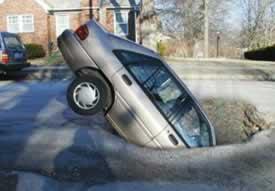
I realize that the true antithesis of a touchpoint would be a painpoint but I think that the pothole is a better metaphor. You're driving along having a pleasant day when — BAM! — you hit a pothole, your car makes a terrible sound, and your
once good mood is suddenly in question.

I bring up potholes because I fell in one earlier today at my neighborhood grocery store. While checking out, an item didn't ring up. "Do you remember how much this cost?" asked the checkout girl. "About $2." This seemed like a fairly accurate estimate. "How much?" she asks again in apparent disbelief. I answer. She chews on her finger and gets a stocker with whom she jokes before sending him on his mission: the price check.

As each minute (and there were several) trickled by I found that all I could do while in their pothole was question my loyalty. "Why do I still shop here?" "Why don't they train their team?" Ridiculous stuff but that's where your mind wanders. The stocker returns. The price: $2.39. I was off by $0.39?!! Do you think the president of this chain would like that $0.39 caused a customer to question their loyalty?

I'm not advocating a policy where customers can name prices (unique though) but potholes like these need to be monitored. Give your staff the leeway to
seamlessly patch a pothole like this in your customer experience. In fact, you should encourage them to do so. What surprises me is how many companies have potholes that customers consistently complain about that are left alone. Think of how communities rally against a city when a pothole gets out of control. What if that was an angry mob of your customers?

The point? Potholes are just as important as touchpoints (if not more so — they cause negative impact). Just like you never know which of your touchpoints builds loyalty, you never know which of your
potholes your customer could fall in on the wrong day and ruin what you've worked so hard to build. With all of this at stake, can you afford to leave any of your potholes un-patched?