My blog has moved!

You should be automatically redirected in 6 seconds. If not, visit
http://westerad.com
and update your bookmarks.

Showing posts with label Motivation. Show all posts

Saturday, February 28, 2009

Good Day

Paul Harvey died this weekend. There are any number of finely worded obituaries you can read about the man whose "rest of the stories" and "good days" punctuated the breakfast tables of my childhood. What I think should be noted is that this 90-year old, who was often cited as the oldest living radio personality and one of the most effective pitchmen ever, was really quite progressive. It occurred to me as I thought back on his show that Paul Harvey was blogging before there were blogs. His daily news and comments with segues to commercial content, all packaged by his folksy delivery — you could have transcribed it and probably have had a great blog but you'd have missed the author's voice and unmistakable inflection. Plus he respected advertising, famously quipping, "I am fiercely loyal to those willing to put their money where my mouth is." Good day, indeed.

Photo credit by Tanki via Flickr

Thursday, February 19, 2009

Copywriter's Time Machine: Ted's Words

Our first client was/is a Cadillac dealership. On the wall of one of their conference rooms is a framed document with advertising copy in it. Yep, ad copy. A copywriter's dream come true — that their words would live on, framed inside conference rooms across the nation. But this is not just any pedestrian copy (I can say that as a copywriter myself). "The Penalty of Leadership" was a legendary Cadillac print ad that ran once in 1915 in the Saturday Evening Post. The words were crafted by Theodore MacManus and they never specifically mention Cadillac.

In 1967 Cadillac revived the campaign by sending scrolls of the copy to customers nationwide, including Elvis Presley. The King so identified with these words, he framed them and hung them up on the walls of Graceland where they still reside today.

Maybe I'm just being sentimental as I'm in the midst of reading The King of Madison Avenue, hearkening back to the long, descriptive, and often poetic ads of David Ogilvy, but copy like this is wonderful. It not only sings but it sells. And not just a car but a lifestyle — an ethos. It paints a picture so clear and vivid in a day where there the only tools for doing so were carefully scribed words on the printed page — long before the colored lights of television and all of the new media that has followed.

Here is the ad, in its entirety.

THE PENALTY OF LEADERSHIP

In every field of human endeavor, he that is first must perpetually live in the white light of publicity. Whether the leadership be vested in a man or in a manufactured product, emulation and envy are ever at work. In art, in literature, in music, in industry, the reward and the punishment are always the same. The reward is widespread recognition; the punishment, fierce denial and detraction. When a man's work becomes a standard for the whole world, it also becomes a target for the shafts of the envious few. If his work be mediocre, he will be left severely alone - if he achieves a masterpiece, it will set a million tongues a-wagging. Jealousy does not protrude its forked tongue at the artist who produces a commonplace painting. Whatsoever you write, or paint, or play, or sing, or build, no one will strive to surpass or to slander you unless your work be stamped with the seal of genius. Long, long after a great work or a good work has been done, those who are disappointed or envious, continue to cry out that it cannot be done. Spiteful little voices in the domain of art were raised against our own Whistler as a mounteback, long after the big would had acclaimed him its greatest artistic genius. Multitudes flocked to Bayreuth to worship at the musical shrine of Wagner, while the little group of those whom he had dethroned and displaced argued angrily that he was no musician at all. The little world continued to protest that Fulton could never build a steamboat, while the big world flocked to the river banks to see his boat steam by. The leader is assailed because he is a leader, and the effort to equal him is merely added proof of that leadership. Failing to equal or to excel, the follower seeks to depreciate and to destroy - but only confirms once more the superiority of that which he strives to supplant. There is nothing new in this. It is as old as the world and as old as human passions - envy, fear, greed, ambition, and the desire to surpass. And it all avails nothing. If the leader truly leads, he remains - the leader. Master-poet, master-painter, master-workman, each in his turn is assailed, and each holds his laurels through the ages. That which is good or great makes itself known, no matter how loud the clamor of denial. That which deserves to live - lives.

Thursday, February 05, 2009

In the Words of Others - Try Something

Last week at the Iowa City Area Chamber of Commerce Annual Banquet, former UI president David Skorton was asked how his love of jazz has influenced him. "You don't know what's going to happen but you have to improvise to find your way through it – like in the current economy. We don't know how it's going to end but we have to try something."

As a trained theatrical improviser myself (long story for another post) I can tell you that I have always felt that improvisational skills strangely translate to the business world. Being on stage without a script or sheet music to follow brings terror but also a certain calm if handled correctly. The secret, as Dr Skorton described, is that you have to jump in and keep an open mind. On stage the golden rule is to say 'yes' to others' ideas as it always keeps the story moving forward.

Now more than ever it seems that folks are being called on to improvise. In our world of careful analysis and review, many are shell-shocked because the playbook has been chucked out the window. Even the experts are flummoxed (see current debate over stimulus plan). What we need is action. Management guru Tom Peters is fond of saying that we need a "bias toward action." His "Ready - Fire - Aim!" philosophy asks us to throw something up on the wall and see what sticks. If it doesn't work, we know that much and can try something else. FYI - Tom didn't say this in response to the current economy. He said it 16 years ago.

Someone else with words of wisdom in dealing with a struggling economy was Franklin Delano Rooselvelt, who famously said: "It is common sense to take a method and try it. If it fails, admit it frankly and try another. But above all, try something."

Finally, we should all heed the advice of Southwest Airlines founder Herb Kelleher: "We have a strategic plan. It's called doing things." Amen, Herb. We can and will get through this. But we cannot be paralyzed by it. Above all, we must remember to try something.

Photo credits - foreverdigital (Skorton), Flanders DC (Peters), Public Domain (FDR), JC Howes (Kelleher)

Monday, January 26, 2009

A Young Mind

Henry Ford once said, "Anyone who stops learning is old, whether at twenty or eighty. Anyone who keeps learning stays young. The greatest thing in life is to keep your mind young." Like Henry, the 25,000 car dealers here at NADA are here to keep their minds young – which is even more important as we face new media and an economy more challenging than ever.

It's not just the dealers, though. If you look at the habits of successful people, we all know that they are lifelong learners. On Saturday Ford CEO Alan Mulally addressed the group and talked about his career change a couple years ago when he joined Ford after a storied career at Boening. Airplanes he knew; cars not so much the CEO humbly said. So what did he do? It's pretty simple. He called up some of his dealers and went to work on the showroom floor selling cars. I say simple but I think that this is a pretty impressive and humbling act and shows that Alan is at least working at keeping his mind young.

I also had the privilege of sitting next to measurement genius J. David Power, founder of JD Power and Associates, at a session. Was he giving the seminar? No. At 77 Mr. Power was sitting down with open ears and mind to hear someone talk about measuring ROI in the age of new media.

Do you work to keep your mind young?

Thursday, January 22, 2009

Anyone Can Be Remarkable

Every business has a story to tell.

Those are the words that first pop up on our agency's website because at our very core that's what we believe. Not only does every business have a story to tell but every business has the opportunity to be remarkable. But this isn't always easy. How many of us have read a Seth Godin book or an inspiring blog post about telling your businesses' remarkable story to the world only to be told by those we answer to "that's all good and well but the [INSERT PERCEIVED BORING INDUSTRY HERE] business isn't like that. We aren't Nike or Apple or Starbucks ..."?

Case in point – many falsely think that banking or the finance industry is sterile and unremarkable. More so now given the sobering news of the day. In fact, many are using the marketplace's need for stability as a reason for sanding out any pointed edges of creativity. (How many big bank CEO's have we seen on TV reassuring recently?) And yet there are those who persevere and tell their story. And sometimes it gets picked up.

Yesterday as I was listening to NPR's Morning Edition, one of their short 0:30-second point-of-interest stories struck me. It briefly told the story of First State Bank in rural Norton, Kansas — a bank with a seemingly unremarkable name that has a wealth of remarkability. You see, First State Bank has a one-of-a-kind portrait collection of all of the losers from every presidential election from Thomas Jefferson to Kansas' own Bob Dole. And how did the bank celebrate the inauguration of Barack Obama on Tuesday? By adding his opponent John McCain to their collection.

That's it. That's all I know about First State Bank in Norton. But if I were told that I had to be a resident of Norton, I might learn over time that there was an older or more prestigious bank in town but I wouldn't have bothered to look because I know the folks at First care about being fun and remarkable with their work. And in times like these especially, it's nice to be around people who care and enjoy their work.

Every business has a story to tell. Every business has the opportunity to be remarkable. But like all opportunities, it only comes to life when someone steps up and takes action on an idea. And that is a very brave thing to do.

Saturday, January 13, 2007

Thinking of the Whole Picture

The following message from Whole Foods CEO John Mackey was distributed to all team members on November 2, 2006. On the same day, the company warned that sales growth would be slow in the year ahead and that its stock had just plummeted. [To be fair, I lifted this from this month's issue of Fast Company. You can also read the full text here.]

To All Team Members,


I want to announce a couple of significant changes regarding compensation at Whole Foods Market.

First, as you know, we have a salary cap policy which limits the total cash compensation that can be paid to any Team Member. The Board of Directors has voted to raise the salary cap from 14 times the average pay to 19 times the average pay, effective immediately ... We are raising the salary cap for one reason only—to make the compensation to our executives more competitive in the marketplace ... Everyone on the Whole Foods Leadership Team (except for me) has been approached multiple times by "headhunters" with job offers to leave Whole Foods and go to work for our competitors. Raising the salary cap to 19 times the average pay has become necessary to help ensure the retention of our key leadership ... This increase to 19 times the average pay remains far, far below what the typical Fortune 500 company pays its executives ... The average CEO received 431 times as much as their average employee received in 2004, while the Whole Foods Market CEO (me) received only 14 times the average employee pay in cash compensation.

Most large companies also pay their executives large amounts of stock options in addition to large salaries and cash bonuses. However, this is not the case at Whole Foods Market. As the chart below indicates, the average large corporation in the United States distributes 75% of their total stock options to only 5 top executives ... At Whole Foods, the exact opposite is true: the top 16 executives have received 7% of all the options granted while the other 93% of the options have been distributed throughout the entire company with all Team Members eligible for a grant after 6,000 hours of service to the company.

The second part of today's announcement has to do with my own compensation ... The tremendous success of Whole Foods Market has provided me with far more money than I ever dreamed I'd have and far more than is necessary for either my financial security or personal happiness ... I am now 53 years old and I have reached a place in my life where I no longer want to work for money, but simply for the joy of the work itself and to better answer the call to service that I feel so clearly in my own heart. Beginning on January 1, 2007, my salary will be reduced to $1 per year and I will no longer take any other cash compensation ... The intention of the Board of Directors is for Whole Foods Market to donate all the future stock options I would be eligible to receive to our two company foundations.

One other important item to communicate to you is, in light of my decision to forego any future additional cash compensation, our Board of Directors has decided that Whole Foods Market will contribute $100,000 annually to a new Global Team Member Emergency Fund. This money will be distributed to Team Members throughout the company based on need ... The first $100,000 will be deposited on January 1, 2007.


With Much Love,

John Mackey

Wednesday, November 29, 2006

Whole Foods Gets It

There was a great story on All Things Considered last night about the in-store artists that Whole Foods employs to create their unique signage. They employ them full time and provide health benefits. Wow. Read or listen to the story and if you're not already familiar with them, learn more about this remarkable business.

Monday, October 30, 2006

The [Non-Business] Business Book

Last week I was in the Denver airport waiting for my flight home and I was faced with an unsettling feeling: I am bookless. There are so many books that I feel I need to read: Freakonomics, The Long Tail, or the one that I thought was at the top of my stack, Small Is the New Big by Seth Godin.

But as I scanned the shelves at the Hudson Booksellers the words of my wife and so many of my colleagues echoed in my head: "If you read another business book next, I'll kill you." Sounds threatening but I really do have a problem with this. It's unintentional. And I'm not trying to brag but I just read these books faster than others.
(I must have a problem with fiction in general. Even when not reading business books, I love non-fiction. Sports non-fiction, memoirs, essays, and biographies.)

I was especially antsy that night because it was Game 3 of the World Series and I had to get to the airport sports bar to watch as much as I could before going "silent" on the plane. (I'm a bit of a Cards fan by default -- they're my son's favorite team. I prefer the more tepid, lukewarm response that I like all Midwestern teams equally.) So it was probably a subliminal thing that led me to purchase 3 Nights in August, Buzz Bissinger's take on a 2003 three-game series between the Cubs and the Cards told through the transitioned lenses of manager Tony LaRussa.

Well, the Series came out just like I wanted it to and the book appears to be headed that way as well. I've also come to the conclusion that 3 Nights in August, is actually what I'm calling
a non-business business book. By that I mean seeing the series through Tony's eyes, you get a feel for the elements of strategic planning and management that go into a game simplistically referred to as "America's past time." You see LaRussa pouring over video and statistics but not being totally driven by them. This is important: he straddles the line of intellect and intuition in a way that is applicable to several aspects of day-to-day life in modern baseball and business.

He also posses what Tom Peters calls a "bias for action." When in doubt, do something. We see LaRussa's now famous (back then, thought to be crazy) experimenting with the injured Albert Pujols' position to get him back into the line up as a perfect example of trying something to get results (which he did).

The Point? I'm not saying Transition Tony is Peter Drucker but you might find this read interesting and surprisingly applicable. Plus, if you're a baseball fan it is a hell of an easier read than Drucker. I think 'The Point' is also like Tony pacing around and tinkering with the line up. You have to expose yourself to all kinds of non-linear things to be open to a crazy idea that could be the equivalent of getting Pujols back into your line up.

P.S. You might also enjoy this post by Tom Peters, if for nothing else than his free PowerPoint on Think vs. Do. Enjoy!

Sunday, September 10, 2006

Talent

Is this an awesome example of true business acumen or am I just falling for Ford's spin?

As everyone knows, last Tuesday Bill Ford Jr. stepped down as CEO of the troubled automaker. (Quick aside: I can't take credit for that descriptor. I read it in an article while talking with an associate. We both agreed that it's never a good sign to be in the car business and have the press refer to you as "the troubled automaker.")

Ford pulled in former-Boening exec Alan Mulally to lead the family business through what may be its darkest hour. Sounds like Mulally is a good find. Primarily because he's been through what Ford is currently going through with Boening in the post 9/11 days. During that period he managed to keep the company in the black through improvements in productivity and product development. Conveniently both are key areas where Ford's North American ops are hurting.

But 'so what' you say. You could have read that in any number of business articles that have offered their take on this changing of the guard over the past week. I point this out because on the same day that the announcement was made, Newsweek subscribers like myself were being delivered an ironic and newly out-of-date interview with Bill Ford Jr. himself.

In it he talks about talent. "I'll always be looking to bring talented people in who can help us." When asked if he would consider replacing himself he replied "I'm looking to make sure this company is stocked with talent ... right now I'm focused on getting the North American operations back on track."

My personal take -- if Ford is on the up and up, he is to be commended for stepping aside and ushering in someone more talented to fill the CEO's office. I think it also makes him an impressive steward to a great American company. What would you do in the same situation? Would you be brave enough to replace yourself with someone more qualified if it guaranteed the survival of your business. "In that regard, I'm not a traditional CEO," Ford said about his quest for talent.

Just to show you all that I'm not Pollyanna, I can recognize that this could all be a marvelously executed PR campaign to protect the very public heir of a very historic business and I could be falling for it hook, line, and sinker. As a marketer, I believe in the power of persuasion and recognize it could be at work here.

Once during The West Wing, someone said something like "I love speech writers. They have to have the capacity to doubt and dream at the same time." I've always thought that the same holds true for marketers. Doubt and dream. Right now, though, I'm in Ford's corner believing in the dream that a major business today is smart enough to replace any key player with someone with more talent who could be doing the job better and add greater value to the company as a whole.

How committed are you to your quest to bring new talent into your company?

Wednesday, August 23, 2006

Black on the Edge of Customer Service

Those of you who know me personally, know I love rage-comic Lewis Black. Those of you who read this blog frequently know that I also love good customer service. So what a treat I got this week when I received the current issue of Fast Company in which they recognize good customer service with their Customer First awards. On the cover was Lewis Black, steam coming out of his ears, with the headline "Is This Your Customer." For me, this is right up there with their issue titled "The Boss from Hell" that featured Mr. Burns on the cover.

And to top it off, this wasn't just Lewis Black "modeling" and setting the tone for the issue with a cover photo. There's actually a great article where "Our customer-service curmudgeon suffers for all of us--but not in silence." It's an insightful read that offers a raw take on the state of service today.

Now take a step back and think about the impact of this cover design. (Actually, you could do this with any of Fast Company's cover designs.) Instead of doing the average BS about "The Customer Service Issue" with some sort of warm and fuzzy customer interaction photo they took it to the edge with the winning concept of the pissed-off customer. But the edge wasn't far enough so they scooted out a bit more and took it from being a generic pissed-off customer to one of America's most notorious pissed-off customers.

So, go to the edge and then move out a couple more inches just to make sure you're far enough!

Take this yet another step back and you can apply the concept of going to the edge to anything from business to backgammon. You can even apply it to the stage persona adopted by Lewis Black. Which would you rather hear? Another comic with a meandering story about airline service gone awry or a jolting rant from a man who appears to be on the verge of an aneurysm? Black even mentions as much in the interview. He recalls studying classical theatre and only discovering comedy because friends told him he was funny when he was pissed off. And the pissed-off thing seems to be working well for Black (regular Daily Show commentaries, three movies coming out, best-selling book, albums, etc.).

So, go to the edge if for no other reason than, to quote a Texas politician, there's nothing in the middle of the road except yellow lines and dead armadillos.

Monday, April 17, 2006

Personal MBA

Josh Kaufman proposes a new type of business education that I think is worth looking at. Maybe, I'm partial to his theory since I consider myself a graduate of his new school.

The Point? Josh sums it up best in the quote from Good Will Hunting below (
P.S. I'd be cheating if I didn't give Seth Godin props for pointing me to Josh's site on his blog.):

“You wasted $150,000 on an education you coulda got for a buck fifty in late charges at the public library.”
- Will Hunting (played by Matt Damon), Good Will Hunting

Tuesday, March 21, 2006

Cliff Gardner

A few years back, me and probably two or three other people watched a short-lived series called Sports Night. It followed the on- and off-camera goings on at a Sports Center-like show.

One of my favorite arcs centered on a fight with the network over low ratings. They bring in a consultant named Sam Donovan (brilliantly played by William H. Macy) who battles the show's team as they struggle to make improvements. When the network intercedes and offers to make the consultant the producer he tells them the following story.
"Do you guys know who Philo Farnsworth was? He invented television. I don't mean he invented television like Uncle Milty, I mean he invented the television.

In a little house in Provo, Utah. At a time when the idea of transmitting moving pictures through the air would be like me saying I've figured out a way to beam us aboard the Starship Enterprise. He was a visionary and he died broke and without fanfare.

The guy I really like though was his brother-in-law, Cliff Gardner. He said to Philo, "I know everyone thinks you're crazy, but I want to be a part of this. I don't have your head for science, so I'm not gonna be much help with the design and mechanics of the invention. But it sounds like in order to do your testing, you're gonna need glass tubes."

See Philo was inventing a cathode receptor, and even though Cliff didn't know what that meant or how it worked, he'd seen Philo's drawing and he knew they were gonna need glass tubes and since television hadn't been invented yet, it's not like you could get 'em at the local TV repair shop. "I want to be a part of this", Cliff said, "and I don't have your head for science. How would it be if I taught myself to be a glassblower? And I could set up a little shop in the backyard. And I could make all the tubes you'll need for testing."

There oughta be Congressional medals for people like that.

I've looked over the notes you've been giving over the last year or so, and I have to say that they exhibit an almost total lack of understanding of how to get the best from talented people. You said before that for whatever reason, I seem to be able to exert authority around here. I assure you, it isn't because they like me. It's because they knew two minutes after I walked in the door that I'm somebody who knows how to do something. I can help. I can make glass tubes. That's what they need.

One last thing: The first and last decision making authority on this show will rest with Isaac Jaffee until Isaac Jaffee says otherwise. And if you disrespect him again in my presence, I'll re-dedicate the rest of my life to ruining the rest of yours. If you think I'm just mouthin' at you, ask around about me, I have absolutely no conscience about these things.

The exit's right there. That's all. The meeting's over."

– Sam Donovan, Sports Night
The Point? I love that story and I think it applies to all of us who are working to produce great work with a talented team. In short, be someone who can make glass tubes.

Monday, March 20, 2006

The Divine Art of Self-Parody

A WesterBlog first: Well done Microsoft!

Recently they posted a parody of what the iPod box would have looked like had their team designed it. "It was an internal-only video clip commissioned by our packaging team to humorously highlight the challenges we have faced RE: packaging and to educate marketers here about the pitfalls of packaging/branding," said Microsoft spokesman Tom Pilla. OK, Tom but it's also a pretty brilliant piece of self-parody.

I'm impressed not only with how funny this clip is but also with the sophistication required to be able to effectively mock oneself which MS surprisingly demonstrates. Anyone who has been a part of a marketing effort that has wandered through development should be able to appreciate this as well.

The Point?
Easy. (Gulp!) Be like Microsoft. Laugh at yourself.

Thursday, March 09, 2006

Got 48 Minutes and One Second?

If so, watch Seth Godin's speech to the staff at Google. Sit back and enjoy this master class in which one of my favorite marketing gurus covers everything from the fall of the TV Industrial Complex to Permission Marketing and Purple Cows. And best of all it's FREE!

The Point? Take a minute (or 48:01!) and recommit yourself to being a life long learner.

Monday, March 06, 2006

Peter, John, and Contribution

Recently I read the late management guru Peter Drucker's classic, The Effective Executive. It more than lives up to its reputation as the definitive work on the subject of self-management and is worth reading and then stepping back and remembering that it was written nearly 40 years ago. Talk about a though leader. Anyone discussing business and management today has to own up to the fact that Drucker was probably there several decades ago.

I followed this up with another modern non-fiction classic, David McCullough's John Adams. In addition to being one of our founding fathers, Adams was himself an effective executive. The quintessential Drucker tenet that Adams exemplified was that of contribution. Drucker maintains that an effective executive focuses on their contribution to their organization -- what they contribute that no one else can that adds value to the organization as a whole.

Case in point, Adams was instrumental in recommending the appointment of George Washington as commander in chief of the Continental Army because he accurately assessed the strengths of the tall Virginian. A year later he would defer the glory of drafting the Declaration of Independence to another Virginian, Thomas Jefferson. As McCullough notes, had he only made these two key contributions, he would still deserve placement in our history books. Say nothing of his work as president of the War Board, numerous congressional committees, his vice-presidency, and later his presidency that helped set the stage for centuries of chief executives.

The Point?
Think of today in terms of your contribution. Think of
Peter, John, and their contributions and go forth and add value to your organization!

Monday, October 31, 2005

Drive Time

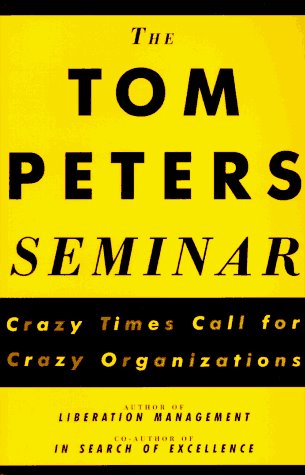
In Seth Godin's recent book, All Marketers Are Liars (a must read), he included a unique item in the appendices. At the end of his great book, he included the titles of several other great books. One was the Tom Peters Seminar: Crazy Times Call for Crazy Organizations. I got the audiobook and listened to it on my way to and from work. What a valuable window of time to get centered for the coming day — especially with Tom's exhilarating referendum on the changing face of business today (it was so good I listened to it twice). I would highly recommend either the book or the audiobook though the author's delivery in the latter adds some extra panache. Again, if you're not taking advantage of your drive time and you haven't read anything of Tom's, go to your bookstore or library right now and pick up this engaging classic.