My blog has moved!

You should be automatically redirected in 6 seconds. If not, visit
http://westerad.com
and update your bookmarks.

Showing posts with label Copywriting. Show all posts

Thursday, February 19, 2009

Copywriter's Time Machine: Ted's Words

Our first client was/is a Cadillac dealership. On the wall of one of their conference rooms is a framed document with advertising copy in it. Yep, ad copy. A copywriter's dream come true — that their words would live on, framed inside conference rooms across the nation. But this is not just any pedestrian copy (I can say that as a copywriter myself). "The Penalty of Leadership" was a legendary Cadillac print ad that ran once in 1915 in the Saturday Evening Post. The words were crafted by Theodore MacManus and they never specifically mention Cadillac.

In 1967 Cadillac revived the campaign by sending scrolls of the copy to customers nationwide, including Elvis Presley. The King so identified with these words, he framed them and hung them up on the walls of Graceland where they still reside today.

Maybe I'm just being sentimental as I'm in the midst of reading The King of Madison Avenue, hearkening back to the long, descriptive, and often poetic ads of David Ogilvy, but copy like this is wonderful. It not only sings but it sells. And not just a car but a lifestyle — an ethos. It paints a picture so clear and vivid in a day where there the only tools for doing so were carefully scribed words on the printed page — long before the colored lights of television and all of the new media that has followed.

Here is the ad, in its entirety.

THE PENALTY OF LEADERSHIP

In every field of human endeavor, he that is first must perpetually live in the white light of publicity. Whether the leadership be vested in a man or in a manufactured product, emulation and envy are ever at work. In art, in literature, in music, in industry, the reward and the punishment are always the same. The reward is widespread recognition; the punishment, fierce denial and detraction. When a man's work becomes a standard for the whole world, it also becomes a target for the shafts of the envious few. If his work be mediocre, he will be left severely alone - if he achieves a masterpiece, it will set a million tongues a-wagging. Jealousy does not protrude its forked tongue at the artist who produces a commonplace painting. Whatsoever you write, or paint, or play, or sing, or build, no one will strive to surpass or to slander you unless your work be stamped with the seal of genius. Long, long after a great work or a good work has been done, those who are disappointed or envious, continue to cry out that it cannot be done. Spiteful little voices in the domain of art were raised against our own Whistler as a mounteback, long after the big would had acclaimed him its greatest artistic genius. Multitudes flocked to Bayreuth to worship at the musical shrine of Wagner, while the little group of those whom he had dethroned and displaced argued angrily that he was no musician at all. The little world continued to protest that Fulton could never build a steamboat, while the big world flocked to the river banks to see his boat steam by. The leader is assailed because he is a leader, and the effort to equal him is merely added proof of that leadership. Failing to equal or to excel, the follower seeks to depreciate and to destroy - but only confirms once more the superiority of that which he strives to supplant. There is nothing new in this. It is as old as the world and as old as human passions - envy, fear, greed, ambition, and the desire to surpass. And it all avails nothing. If the leader truly leads, he remains - the leader. Master-poet, master-painter, master-workman, each in his turn is assailed, and each holds his laurels through the ages. That which is good or great makes itself known, no matter how loud the clamor of denial. That which deserves to live - lives.

Friday, January 16, 2009

The Copywriter's Time Machine


Yesterday, while mourning Ricardo Montalban (KHAAANNNNN!) I happened upon the above spot for the 1975 Chrysler Cordoba. I have to admit, it kept me laughing for about a half hour solid. Not just the fine corinthian leather but the tastefulness of its appearance and Ricardo's winsome look as he reflects on how the Cordoba answers his demands.

But this is where it gets weird. After I stopped laughing, I started thinking. And thinking. The spot stayed with me. Once you get past the campiness (his stylish neckerchief, the buttons on the seats) you realize that the copy is really well written. What's more important is that it makes a statement about the brand that evokes very specific images and aspirations. No small coincidence that it helped Chrysler sell a whole lot of this small car in the mid to late '70s. RIP Ricardo. Now what about Chrysler ...?

On a slightly related note ... a week from today Dean and I arrive in New Orleans for the National Automobile Dealers Association Annual Convention & Expo. We're eager to hear what industry experts have to say. We'll blog from the convention and maybe even snap a few shots from the trade show floor.

Monday, October 16, 2006

I'm Taking Pictures of My Trash Again


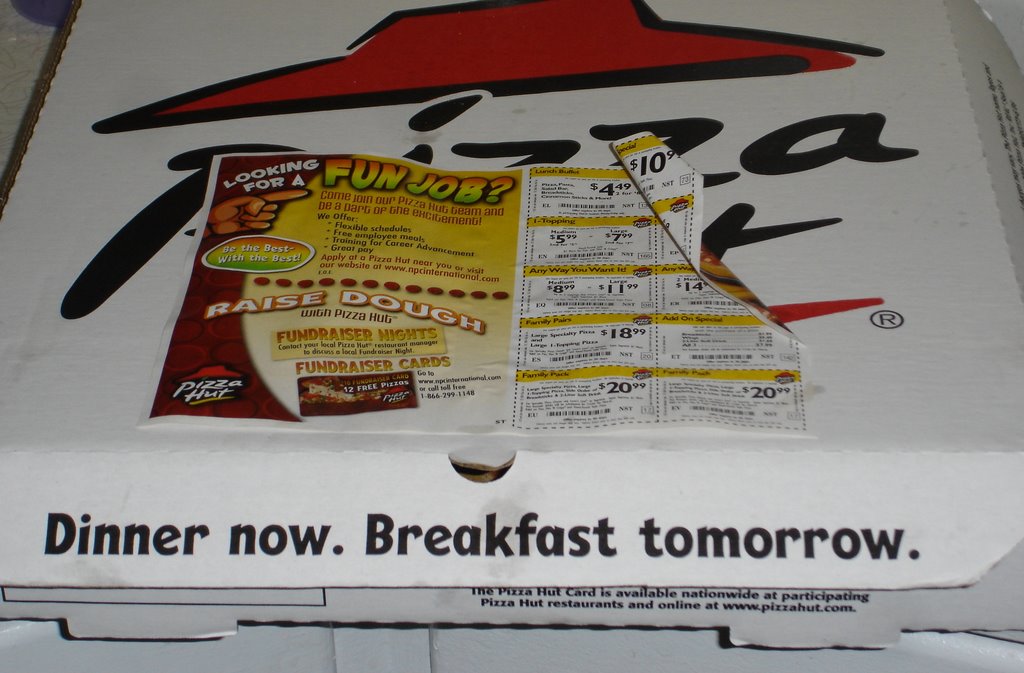
Again, you say? Yes. As some of you may remember I was similarly moved by some fast food packaging that I had to photograph and blog about pre-trash last year. Anyhow, I love this Pizza Hut box because they took advantage of their packaging to touch on a unique product need. "Dinner now. Breakfast tomorrow." Those four simple words sum up the added value of ordering pizza. Some clever copywriter took a personal moment of product interaction - not just the key customer need of satisfying immediate hunger - and found a way to market to it. Those sentences remind us why we have twice as much pizza delivered as we need.

The Point? Embrace and find a way to market to an atypical use for your product. I say embrace because I remember the story about the Preparation H marketing exec on the ski slope that begrudgingly admitted that a number of their customers (the skiing exec included) used the product as an exceptional cold weather lip balm. Now what if they found a way to embrace that need and market to it. And finally,
remember that it's not just a box, or a sack, or an invoice. It's a piece of advertising that will be laying around your customer's home or office. Make the most of your packaging or I'll be forced to take more pictures of my trash!

Sunday, May 28, 2006

Coffee Posting #2

After my previous posting about Starbucks' magical copy, I must have been in a cup-reading type of mood ...

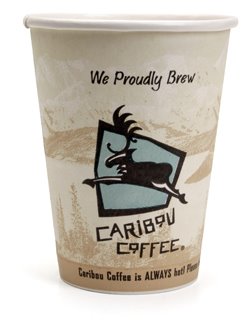
Truth be told, nowadays my wife and I actually more frequently get our daily java fix (she shuts down if she doesn't have her Vanilla Coffee Cooler, no whipped cream) from the newly opened Caribou Coffee. For those of you who don't know them (and you may not since they are only in a handful states), Caribou is number two in the gourmet coffeehouse biz. Think of them as Starbucks' quirky, socially conscious (cool positioning) cousin from the northwoods of Minnesota.

To be blunt they are second but it is a distant second to the clear market leader. But it's also a strong second. They have built a brand every bit as powerful as their erudite older cousin. Caribou's coffeehouses are like little lodges complete with faux fireplace, raw woodwork, and probably faux bearskin ottomans.

To do an apples to apples comparison with my previous post, how does their cup copy compare to the 'Bucks juggernaut?
You are holding our pride and joy

Hand-selected beans. Hand-crafted beverage.
It's in your hands now. Enjoy.
Not bad. And actually those simple phrases sum up their position in the market in an eloquent and concise fashion. They care about the coffee experience that Starbucks has sold us on. Pay a few bucks more and you enjoy a incomparable drinking experience. They acknowledge your involvement in this experience by referencing your enjoyment in tandem with their joy in creating it. The whole feel of their brand is targeted at coffee connoisseurs who may be after a more relaxed, lived in environment. Outdoorsy and soothing. Kick back by the fire and enjoy.

On a side note, their aforementioned social consciousness is easily felt with several signs proclaiming their support of social and agricultural responsibility in coffee production. Again, good differentiation but to be shrewd for a moment when they proclaim this so fervently it begs the question 'What does Starbucks do socially?' Probably a lot, perhaps even more given their size but they don't communicate it as prominently as Caribou and thus it escapes being a core component of their brand identity. To paraphrase James Carville, don't expect the public to know something unless you're willing to tell them.

The Point? There's something to be said for being a strong and respectable number two. In the end, you may even be number one in other measures that outweigh market leadership. Think Apple. Think Caribou. Think different. Happy Memorial Day!

P.S. I'll lay off the coffee posts for a while.

Saturday, May 20, 2006

Magical Copy

STOP THE PRESSES!!

A marketing blog about Starbucks' unequivocal branding? Really ...???


No, I'm not hurting for topics but I'm daring to tread where -- um, like, every other marketing wonk has tread before. The holy grail of branding: Starbucks.


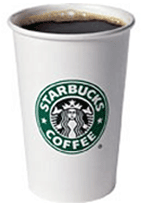
On a recent business trip I was killing time while enjoying a cup of my favorite Starbucks brew (plain ol' house dark roast, black) and was bored enough to actually read my coffee cup. And what nuggets of info does the cup contain? Caution: Hot! (McDonalds, trying dodge yet another suit). A little diagram on how much ice to put in (Burger King. -- like someone doesn't know? Like you could maybe mess that one up?? I digress). No, the copy on the Starbucks cup simply read:

There is a hidden magic in Starbucks coffee; proper brewing releases the subtle bouquet of flavors stored in each bean.
Wow. That, my friend, is why we pay 3-4 times more for Starbucks. With a story like that how could you possibly get anything else? Or, conversely, how could you not believe that Starbucks' coffee is better? This cup (a cup for crying out loud!) can teach us so much:
  1. Talk about Copywriting 101. Take note: the imagery, the heightened language.
  2. Not to mention Branding 201: Never underestimate any little bit of packaging. We all know it would be easier, cheaper, etc. to just order plain old boxes. But if you go that extra mile you could have a customer for life.
  3. Finally it drives home either Tom Peters' WOW! Factor or Seth Godin's Purple Cow. Take your pick ...
The Point? Go there. Write magical copy. Create transcendant products and services. You don't just sell widgets! You sell an experience unlike any other. And if you don't believe that, well then, they'll always be a need for someone at the bottom for the people at the top to look down on. Oh, that and whatever you currently pay your copywriter ... double it and see what happens.

P.S. Just to show you the perceived value of the Starbucks cup with its magical copy ... While I was searching for an image for this post my Google image search brought up dozens of cups that people had taken pictures of and posted. The cup and its ideas have enough value for people to want to share them with their friends. Wow, indeed.

Thursday, April 06, 2006

Hot Tip: The Lowdown on Email Subject Lines

As an email marketer, I've been known to spend a substantial amount of time crafting the perfect subject line. It's a big deal. It effects open rates. It's a split second you have to capture your recipient. It's like having a good teaser on the outside of your direct mail package.

No surprise yet, right ... Well, recently I conducted an experiment on carrying this practice over to my internal emails to clients and co-workers. Rather than typing 'Question' or 'Project Update' or 'Re: The Twelve Previous Emails We've Exchanged' in the subject line, I starting taking a couple of seconds to craft a zinger. 'Cause who doesn't feel like they send their emails out into cyberspace and into a co-worker's overflowing mailbox. In theory, if you want attention from a client or colleague shouldn't you employ the same tactics as the rest of the noise?


The results? No surprise here either. My own internal email response rate went through the roof when I go with a quirky subject line from left field like 'Fuel for Your Fire' or 'Caution: Low Ceiling' or 'You Can Thank Me Later.'


The Point? Am I crazy. Well, hell yes but I'm a crazy person who people respond to.

Tuesday, November 01, 2005

The Complexity of "Easy to Use"

You're sitting down to discuss your message strategy with your boss or client. He's listing off the product or service's core features and rounding out the list is its ease of use. Gulp! You're really in trouble if the first two on the list were the product's high quality and low price.

That's because "easy to use" is now an equal to "high quality" and "low price" when it comes to cliche product features. Bernard Taper asserted, "a cliche is a truth that no one believes." You can now join me in welcoming ease of use to this auspicious club of cliches that no one believes anymore.

More importantly,
your customers now expect ubiquitous product features like easiness. What can you do? Exclude ease from your messaging? No. You just need to use some additional tools to better define the complex issue that is your product's ease of use.

Target the Solution
In order to be considered "easy," your product or service
presumably makes some aspect of your customers' life easier. Find that fulcrum and leverage it. Focus on what is actually made easy for the customer by your product and less on the general malaise of your product's ease.

Design Easy

(Designers take note: I didn't say design was easy!). Isn't it ironic when you're reviewing marketing collateral touting a product's ease of use and the piece itself is busy, text-heavy, and overly complicated? One of the most powerful ways to communicate your product's ease is through design. Convey ease through design that is open, deliberate, and simple.

Putting It All Together
Part of the reason that product ease became cliche is that too many marketers became dependant on the generic label of "easy to use." This is not enough anymore. You need to develop a system of ease into your message strategy that incorporates the ease to the customer and pulls in elements from your product development cycle. This allows you to tell your product's story of ease, loaded with features, within the context of your customer's problem. With your system of ease packaged, you wrap it up in the ease-centered design touched on above.

So next time you get the complex assignment of selling "easy," remember to use these three tools to help you define it.

Friday, October 28, 2005

Building Anticipation into New Product Releases (Taking a Lesson from NBC)

New products don't just appear and fly off the shelf. You have to have a focused strategy for releasing or launching your new products. This is a very complicated message that warrants special attention.

When telling your audience about something new, you need to grab their attention out of the gate and sustain it through your call to action. This requires a flair for the theatrical. Where to look for inspiration? No further than your TV.

Programming has become so saturated with excess noise that it's become even more critical to highlight the need to tune in next week. For my money, no one does this better than NBC's dramas. ER and The West Wing have always made you feel like your life depended on seeing next week's episode.

Do your research at the end of the next installment of one of these dramas when they show the "scenes from next week." Here are some things to take note of:
  • The Copy — Dramatic words! "Coming Soon!" "Next week a special baby brings the ER together ... a deadly outbreak ... and one of the doctors says goodbye to the ER forever." To help you focus, imagine the preview voice-over guy delivering your copy and don't stop editing 'til it fits. Stop laughing! This is not a joke.
  • Hit the Dramatic Highpoints — Have you noticed that these 30-second spots (that I wager to say are edited together almost as meticulously as the episode itself) always show the fights, sex, and the dramatic pauses? Find a way to pull the most dramatic features out for your new product launch.
  • Rhythm and Pace — These previews always utilize rhythm and pace to get you comfortable and then jostle you. Mix up your presentation to keep your audience from getting too comfy.
  • "Leave Them Wanting More" — One of the oldest showbiz adages. Just like these scenes don't tell you which doctor is leaving the ER forever or what deadly disease is on its way, remember to stop short at the end. I'm not saying incomplete, I'm saying get them close enough to the edge so they have to jump.
  • Next Week Isn't Enough — This is the newest trend. Not just showing scenes from next week, but showing scenes from the next four weeks. Why settle for a week's commitment when you can get a month. Do you have a series of new products you are releasing over the next few weeks/months? Consider copping this strategy and piggybacking your releases. Use one launch to get your audience primed for the next one.
The point? Now that you have all of the tools you need, infuse your new product release with these trusted tools of an industry that knows a thing or two about enticing an audience and building anticipation for what's to come.