
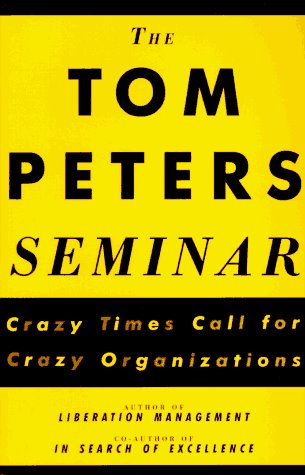
 In Seth Godin's recent book, All Marketers Are Liars (a must read), he included a unique item in the appendices. At the end of his great book, he included the titles of several other great books. One was the Tom Peters Seminar: Crazy Times Call for Crazy Organizations. I got the audiobook and listened to it on my way to and from work. What a valuable window of time to get centered for the coming day — especially with Tom's exhilarating referendum on the changing face of business today (it was so good I listened to it twice). I would highly recommend either the book or the audiobook though the author's delivery in the latter adds some extra panache. Again, if you're not taking advantage of your drive time and you haven't read anything of Tom's, go to your bookstore or library right now and pick up this engaging classic.
Monday, October 31, 2005
Drive Time
In Seth Godin's recent book, All Marketers Are Liars (a must read), he included a unique item in the appendices. At the end of his great book, he included the titles of several other great books. One was the Tom Peters Seminar: Crazy Times Call for Crazy Organizations. I got the audiobook and listened to it on my way to and from work. What a valuable window of time to get centered for the coming day — especially with Tom's exhilarating referendum on the changing face of business today (it was so good I listened to it twice). I would highly recommend either the book or the audiobook though the author's delivery in the latter adds some extra panache. Again, if you're not taking advantage of your drive time and you haven't read anything of Tom's, go to your bookstore or library right now and pick up this engaging classic.


Sunday, October 30, 2005
Something Spooky for Halloween: Selling to the Inside Champion
 In honor of the holiday, I thought I'd share something scary — 5 marketing messages that my five-year old spontaneously regurgitated throughout the past week.
 - McDonald's Proudly Sponsors ... The punch line is we try to get the kids to watch PBS because there are less commercials but he still remembers the sponsorship message. This is good news for companies with sponsorships though ...
- Nike — What can I say? The swoosh works. He tried on a pair of Nikes recently and now he notices every pair he sees.
- Scholastic Video Collection — He knows the books. He knows the logo. He knows the videos. I guess he has a pretty firm handle on their entire brand hierarchy.
- Beaches Family Resorts — I don't know where this came from or what it is. That's a first: I'm hearing about a brand through my son.
- Coming Soon on Disney DVD and Video — No big whoop. Every kid knows Disney but kids today are so familiar with the mouse they even understand their promotional strategy. He already gets Disney's anticipation game (that's why he's terrified of movies going into the infamous "Vault Disney").
Friday, October 28, 2005
The WesterBlog Week in Review
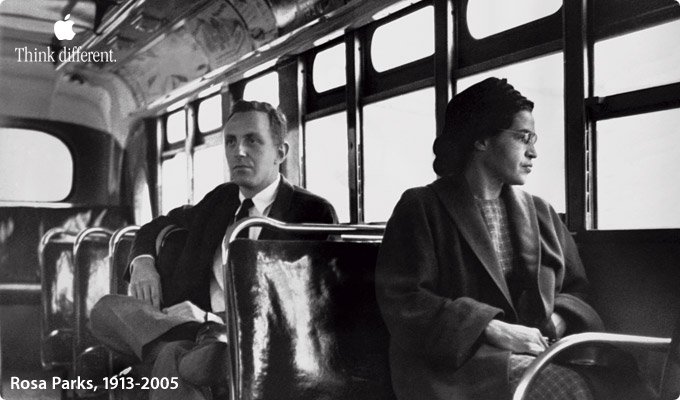
First and foremost, let me clarify that I am in no way affiliated with Apple Computer. Their marketing is just a constant marvel to me and worth sharing. The image above was the main graphic on the gateway to Apple's site this week, the same week as Ms. Parks passing (Note: at the time of this posting, they had changed the ad back to iPods — trust me though, it was there). This symbolizes the WesterBlog coming full circle after its first week for two reasons: it uses an example from Apple and it also echoes several topics from this past week's posts.
- Come for the Buzz. Stay for the Innovation was my first major post (also citing an Apple example). Note that this image is a pick-up from Apple's "Think Different" campaign. Now compare it with the invite to the iPod video event. Apple's branding has been remarkably consistent. The strength of their brand over time has become one of the company's most valuable assets and has more than offset their weak overall market share. Seeing this image again reminded me of the power of this campaign. Wow!
- Maximize Your Touchpoints reminded us to do just that. Cover all of your bases with consistent messaging because you never no which of your touchpoints ends up creating a loyal customer. One of Apple's biggest touchpoints is the homepage of their site and they always maximize this with a relevant product ad. Not this week, though, because someone at Apple ...
- ... spoke up bravely at a meeting. This was covered in Time for a New McStrategy. I can imagine the weekly meeting of Apple's online marketing team where someone was wondering whether or not to share the fact that they remembered the company featuring Rosa Parks in the "Think Different" campaign and wouldn't that be a powerful way to honor her memory this week. They probably weighed the option of speaking up with the backlash that would ensue ("We're in the middle of a big iPod push right now and can't afford to get off message") and decided to make the bold choice and sell the team on thinking different about branding for a week.
Building Anticipation into New Product Releases (Taking a Lesson from NBC)
 New products don't just appear and fly off the shelf. You have to have a focused strategy for releasing or launching your new products. This is a very complicated message that warrants special attention.
When telling your audience about something new, you need to grab their attention out of the gate and sustain it through your call to action. This requires a flair for the theatrical. Where to look for inspiration? No further than your TV.
Programming has become so saturated with excess noise that it's become even more critical to highlight the need to tune in next week. For my money, no one does this better than NBC's dramas. ER and The West Wing have always made you feel like your life depended on seeing next week's episode.
Do your research at the end of the next installment of one of these dramas when they show the "scenes from next week." Here are some things to take note of:
- The Copy — Dramatic words! "Coming Soon!" "Next week a special baby brings the ER together ... a deadly outbreak ... and one of the doctors says goodbye to the ER forever." To help you focus, imagine the preview voice-over guy delivering your copy and don't stop editing 'til it fits. Stop laughing! This is not a joke.
- Hit the Dramatic Highpoints — Have you noticed that these 30-second spots (that I wager to say are edited together almost as meticulously as the episode itself) always show the fights, sex, and the dramatic pauses? Find a way to pull the most dramatic features out for your new product launch.
- Rhythm and Pace — These previews always utilize rhythm and pace to get you comfortable and then jostle you. Mix up your presentation to keep your audience from getting too comfy.
- "Leave Them Wanting More" — One of the oldest showbiz adages. Just like these scenes don't tell you which doctor is leaving the ER forever or what deadly disease is on its way, remember to stop short at the end. I'm not saying incomplete, I'm saying get them close enough to the edge so they have to jump.
- Next Week Isn't Enough — This is the newest trend. Not just showing scenes from next week, but showing scenes from the next four weeks. Why settle for a week's commitment when you can get a month. Do you have a series of new products you are releasing over the next few weeks/months? Consider copping this strategy and piggybacking your releases. Use one launch to get your audience primed for the next one.
Wednesday, October 26, 2005
Time for a New McStrategy?
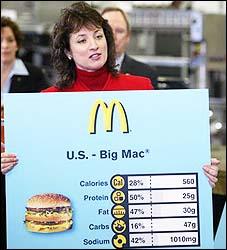 In case you missed it, Mickey D's announced today that it will print nutrition facts on the wrappers of its infamous Big Macs, fries, etc. All of this is in response to mounting pressure that fast food causes McObesity and could lead to a McHeart Attack.
McDonald's: We get it. You're trying.
But what about a totally different strategy — a complete 180. Come out and say, "Eating here every day can lead to all of that but it's no different than dining out anywhere else every day. Go make a burger and fries at home and it's not going to be much healthier. Our food is meant to be a treat or a convenience food — not a key component of your daily sustenance." The golden arches have been 'responding' for so long that they've stopped doing anything remarkable.
Tom Peters talks about the Detroit auto assembly measure of TGW (Things Gone Wrong) for measuring assembly line efficiency. He points out the fundamental shortsightedness of this and encourages thinking in the more Eastern view of Things Gone Right.
McDonald's should supersize this strategy. For proof they need look no further than their competition, gaining traction by not being too big to change it up through innovation. By inventing a Thickburger like Hardee's or touting the extreme customization of BK's "Have It Your Way." McDonald's would rather print packaging defending the old model than take a bold stance one way or the other — either drop the menu that's gotten them into trouble (risky) or embrace it and build on it ("Yeah, we make burgers and they're about as healthy as burgers can get but they are also the best burgers in town").
The McPoint? Don't spend all of your valuable resources educating your customers on the box you've let yourself get confined to. Innovate your way back out of the box. What's sad is that this isn't rocket science. I'll bet you someone in a strategy meeting at the McDonalds HQ had this thought and was either too scared to say it or was laughed out of the room. There are worse things than being laughed out of the room. After all, it's easier to smugly sit on big ideas, saving them for the inevitable "I told you so" after the fact, than it is to bravely put the big idea on the table in front of your peers. Go forth and speak up at your next meeting.
P.S. I've written two fast food-themed blogs in the past week! Maybe I should be checking the nutrition facts on my wrappers more closely...
Tuesday, October 25, 2005
Can't Afford to Be a Day Late
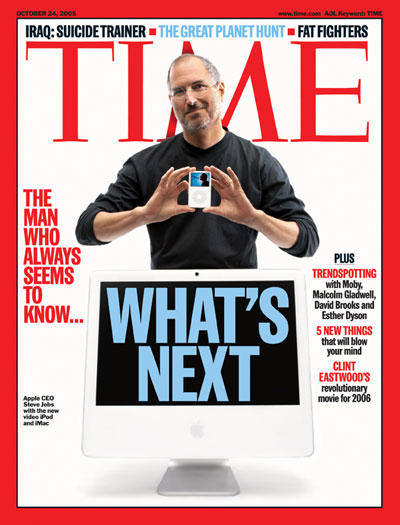 Last week Time had a great issue titled "What's Next" — a look at what's cool now and what's next. There's a detailed feature looking at how Apple's leadership keeps innovation alive (equal parts collaboration and control). It also has several articles about fun new gadgets as well as a roundtable on Trendspotting with Malcolm Gladwell, Esther Dyson, and Moby. I meant to get this posted sooner when you could still go out and grab a copy but alas, I checked today and it's off the shelve. You can read most of the articles free at the Time Archive. Enjoy!
Monday, October 24, 2005
... And Don't Forget to Patch Your Potholes
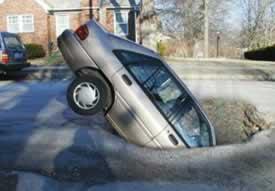
Yesterday, I encouraged you to walk through your customer experience to maximize your touchpoints. While looking for touchpoints, keep your eyes pealed for potholes in your customer experience.
I realize that the true antithesis of a touchpoint would be a painpoint but I think that the pothole is a better metaphor. You're driving along having a pleasant day when — BAM! — you hit a pothole, your car makes a terrible sound, and your once good mood is suddenly in question.
I bring up potholes because I fell in one earlier today at my neighborhood grocery store. While checking out, an item didn't ring up. "Do you remember how much this cost?" asked the checkout girl. "About $2." This seemed like a fairly accurate estimate. "How much?" she asks again in apparent disbelief. I answer. She chews on her finger and gets a stocker with whom she jokes before sending him on his mission: the price check.
As each minute (and there were several) trickled by I found that all I could do while in their pothole was question my loyalty. "Why do I still shop here?" "Why don't they train their team?" Ridiculous stuff but that's where your mind wanders. The stocker returns. The price: $2.39. I was off by $0.39?!! Do you think the president of this chain would like that $0.39 caused a customer to question their loyalty?
I'm not advocating a policy where customers can name prices (unique though) but potholes like these need to be monitored. Give your staff the leeway to seamlessly patch a pothole like this in your customer experience. In fact, you should encourage them to do so. What surprises me is how many companies have potholes that customers consistently complain about that are left alone. Think of how communities rally against a city when a pothole gets out of control. What if that was an angry mob of your customers?
The point? Potholes are just as important as touchpoints (if not more so — they cause negative impact). Just like you never know which of your touchpoints builds loyalty, you never know which of your potholes your customer could fall in on the wrong day and ruin what you've worked so hard to build. With all of this at stake, can you afford to leave any of your potholes un-patched?
Subscribe to:
Posts (Atom)


